BauTV+ NewsBlog · Site Security
Construction Site Theft: What Cameras Really Prevent
- construction site theft
- site security
- camera evidence
- insurance
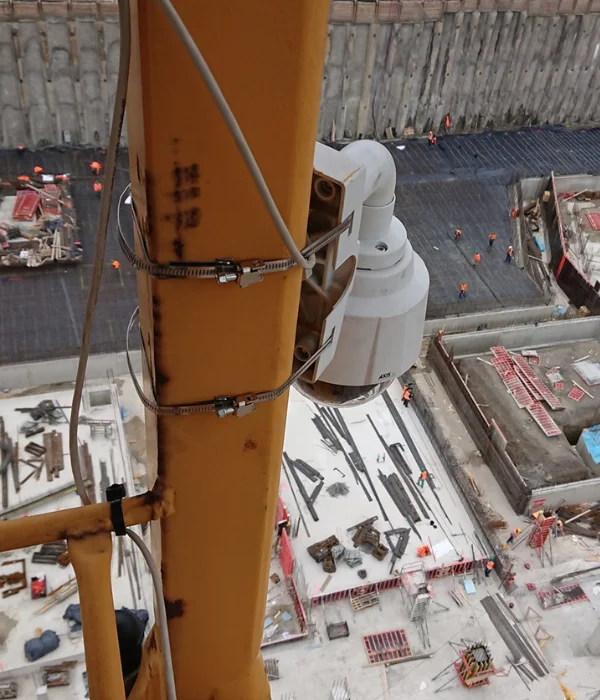
A site manager who has run more than one project has usually lost a battery drill, a coil of copper cable, or a pallet of fittings to someone who had no business being on site after hours. The pattern repeats across the UK, the Netherlands and Germany with only minor local variation. Knowing what disappears, when, and why a camera on a pole is not a guard at the gate helps direct the security budget where it changes outcomes.
What actually goes missing
Hand tools and cordless power tools top the list: small, resellable, rarely marked. Copper cable and pipework come next, once first fix is complete and reels sit staged for second fix. Diesel from generators is a recurring target on sites without bunded, lockable tanks; small plant such as compressors and wacker plates walks off when left unchained overnight. In the final fit-out phase, sanitaryware, ironmongery and light fittings go missing between delivery and installation, often because the delivery note says the material is “on site” while it sits unsecured in a corridor.
Timing follows a predictable curve. Weeknights on unoccupied sites are common, but weekends and public holidays carry higher risk because the gap between the last person leaving and the first arriving is longer. The 48 hours after a large delivery are a known weak point: pallets sit visible from the road, not yet moved into a container. The final fit-out stretch is another weak point, since value per square metre peaks while access control loosens as more trades move through.
Interval documentation cameras versus live security systems
These solve different problems.
An interval documentation camera takes still images at fixed intervals, commonly every 15 to 60 minutes, and stores them as a time-lapse record of the build. It has no live monitoring, no alarm, and typically no audio. Its value is retrospective: after something has happened, you pull the frames around the relevant window and see who or what was on site, or whether a delivery arrived as documented. More on how this differs from live monitoring: construction site monitoring overview.
A live security system is built to intervene while an event happens. It runs continuous or motion-triggered video, sends an alert to a control room or a phone, and often adds an audio challenge telling an intruder they have been seen. Some systems escalate to a dispatched guard: the layer that can interrupt a theft in progress.
The mistake worth naming directly: a camera capturing one frame every 15 minutes will not stop someone loading a van in the ten minutes between exposures. Its job is documentation, not intervention, and buying one to solve the other problem wastes money.
Where documentation cameras earn their keep
Even without live alerting, an interval camera pays for itself in the paperwork after a loss. It fixes a timeline: if a subcontractor claims materials were delivered and stacked correctly, the stills show pallet count and condition at drop-off, settling disputes about custody. Insurers asking for evidence of a break-in get a dated image sequence instead of a verbal account reconstructed weeks later.
BauTV+ documentation cameras capture an image every 15 minutes by default and host the data in the EU, which matters when a claim needs a verifiable record rather than a phone photo with no reliable timestamp.
The layered approach that actually reduces losses
No single measure closes the gap. Sites with the fewest losses combine several cheap, boring controls rather than one expensive one.
| Risk situation | Recommended measure | Role of the camera |
|---|---|---|
| Open, road-facing perimeter | Fencing, gates, lockable access | Documents breach, does not prevent it |
| High-value delivery on site | Just-in-time delivery, move to lockable storage | Confirms delivery time and quantity |
| Small plant left overnight | Ground anchors, wheel clamps, registered plant | Evidence for insurer and police report |
| Final fit-out, high value per m² | Tighter key control, less trade access after hours | Timeline for disputes between trades |
| High-theft area or history of incidents | Live monitoring or guarding, alarm response | Only layer that can interrupt an event |
| General deterrence | Visible cameras and signage | Supports legal basis for footage use |
Fencing and controlled gates remain the baseline; a site anyone can walk onto has lost the argument before a camera is installed. Lighting removes the cover of darkness most opportunistic theft relies on. Lockable storage, bolted or anchored rather than free-standing, takes the easiest targets off the table. Just-in-time delivery of expensive fixtures shrinks the window they sit exposed. Marking and registering plant makes it harder to resell and easier to trace. Clear key-holding rules, with a log of who has them, close the failure mode where a key gets copied and never accounted for. Live monitoring or guarding belongs on sites where the risk justifies the cost: a history of break-ins, an isolated location, or a fit-out phase carrying six figures of loose material.
Deterrence and the legal basis for signage
Visible cameras and clear signage do measurable work even when the camera behind the sign is a documentation-only model. Someone casing a site for opportunistic theft looks for the path of least resistance, and a camera housing plus a sign stating the site is monitored shifts that calculation. In most European jurisdictions, signage also forms part of the legal basis for recording people, since it puts anyone entering on notice that images may be captured. Skipping the sign to save five minutes on installation day is a common, avoidable gap. See the GDPR-compliant construction site documentation guidance.
Data protection limits you cannot design around
Continuous surveillance of workers and public areas needs a far stronger justification than interval progress documentation; the two are not interchangeable under data protection law. A still every 15 minutes for progress and evidence purposes is a light-touch form of processing. A continuous feed of workers through their shift, or a camera catching a public footpath, typically needs a documented legal basis, a retention policy and, in several jurisdictions, consultation with a works council.
Keep neighbours’ windows, gardens and public paths out of frame wherever the layout allows it. Where people are recorded, automatic pixelation reduces the personal data captured; BauTV+ applies this by default. Restrict who can access stored footage, and check national rules first: the UK, the Netherlands and Germany set their own thresholds for proportionate surveillance, and what passes in one does not automatically pass in another.
A three-step check before the next site start
Before mobilising a new project, walk the perimeter and note every point where a person or vehicle could enter without passing a gate. Decide, in writing, which measure covers each risk situation in the table above rather than defaulting to “we’ll get a camera.” Confirm who owns the footage, how long it is kept, and who signs off before it is shared with an insurer or the police. That conversation, held once at the start rather than after the first loss, turns a camera from a box on a pole into part of an actual security plan.