BauTV+ NewsBlog · Time-Lapse
Time-Lapse Construction Documentation: A Practical Guide
- time-lapse
- construction documentation
- camera position
- progress film
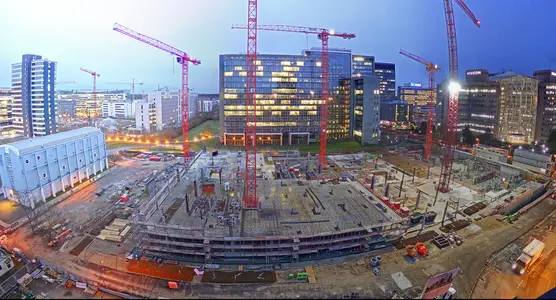
Time-lapse footage turns eighteen months of concrete, steel and cladding into two minutes a client, a lender, or a graduate hire will actually watch to the end. A usable film, rather than a folder of shaky, backlit stills, comes down to three decisions made before the first frame is shot: where the camera sits, how often it fires, and what happens to the files afterwards.
Why teams shoot the film in the first place
A time-lapse rarely exists for one reason alone. Marketing teams cut sixty-second clips for social media and hero videos. Investors and joint-venture partners get a still or a short clip with the monthly progress report, evidence the programme is moving without a site visit. Site managers pull single frames to settle disputes about when a delivery arrived or formwork was struck. At handover, the film joins the completion pack, often the only record a facilities team ever sees of what sits behind the finished walls. Recruiting teams reuse the footage on careers pages, since a structure rising in fast motion says more about a contractor’s capability than a stock photo of a hard hat.
Marketing wants drama and light, investors want a repeatable read on progress, a site manager wants a defensible timestamp. Deciding which matters most before the camera goes up saves a second site visit later.
Fix the camera position before groundworks starts
The most common failure is picking a spot that works for the first three months and nothing after. A camera watching the excavation often ends up staring at the back of a completed building by month eight, because nobody checked the approved elevations against the sightline.
Four checks before the bracket goes on:
- Trace the crane’s slew radius on the site plan and keep the camera outside it, with clearance for the jib at its lowest working height.
- Overlay the final building height and footprint on the view; a vantage point that works in month one can block its own site by month six.
- Check sun position across the seasons the build will run through, not just installation day. East-facing cameras can lose every morning frame to flare for weeks around the equinox.
- Confirm the mounting structure will still stand when the camera needs its last frame. Brackets fixed to structures due for early demolition are a routine error.
Neighbouring buildings, a different contractor’s tower crane, and permanent hoarding are the anchor points worth checking first. A dedicated construction site camera mounted correctly tends to run untouched for the contract; one mounted in a hurry gets moved at least once, and every relocation shows up as a jump cut in the film.
Interval: the arithmetic that decides how the film feels
Interval choice is arithmetic, not taste. A 15-minute interval across a 12-hour daylight window gives 48 frames a day (12 hours times 60 minutes, divided by 15). An 18-month programme runs roughly 540 calendar days, or 390 on a Monday-to-Friday shoot, so 18,720 to 25,920 frames depending on weekend inclusion. At 25 frames per second the raw sequence runs 12 to 17 minutes. The finished film, once someone picks the best sky and drops in a few milestone captions, lands at two to four minutes.
That default does not suit a concrete pour, a steel lift, or a controlled demolition, all of which finish inside hours or seconds and vanish entirely at a 15-minute interval.
| Event | Typical duration | Suggested interval | Frames captured |
|---|---|---|---|
| Full programme, groundworks to handover | 12–24 months | 15 minutes | tens of thousands |
| Concrete pour | 4–10 hours | 1–2 minutes | roughly 120–600 |
| Steel erection or crane lift | 2–6 hours | 1–3 minutes | roughly 40–360 |
| Controlled demolition | seconds to minutes | 1–5 second burst | dozens |
For short, high-value events, run a second camera on a tight interval rather than switching the main unit’s setting and forgetting to switch it back.
Day, night, weekends and weather
A fixed interval captures whatever sits in front of the lens, including twelve hours of a dark, empty site every night. Most programmes cap capture to daylight hours rather than filming a black frame for ten hours straight; weekend frames stay in by default, since a site under snow or standing scaffolding is still useful continuity even with nobody on it.
Weather causes the failures hardest to spot afterwards. Fog erases a week of frames without anyone noticing until the edit, and rain on an unprotected lens leaves a blurred smear across one corner. A housing rated for the local climate, plus a cleaning check on the same schedule as other site inspections, catches both before they become a gap in the film.
One camera or several, and when to move one
Large sites, or sites with more than one build phase, often need two cameras: a wide shot for the marketing cut, and a closer angle on the structure a client or lender cares about. Relocating a camera mid-programme is sometimes unavoidable when a crane comes down or a hoarding line moves, but the position checklist runs again, sun check included, or the second half of the film will not match the first in exposure and framing.
Deliverables, ownership and permissions
A useful brief specifies deliverables before the camera goes up. Typical outputs:
- a full-resolution master file covering the entire duration
- shorter clips split by construction phase (groundworks, structure, envelope, fit-out)
- individual stills for progress reports, plus vertical cuts sized for social media
Ownership belongs in the contract. Footage of a joint venture, or a site with more than one contractor under one main contractor, is worth a one-line clause on who can use the final film and where.
Anyone with a public path, a neighbouring building, or a residential window in shot has a legitimate interest in what the camera records; a GDPR-compliant approach that pixelates people in frame covers most of that. BauTV+ does this automatically, hosts footage on EU servers, and defaults to a 15-minute interval most programmes never adjust. The workforce should also know a camera is running; a line in the induction avoids an awkward conversation later.
Five mistakes that show up in almost every film
Five errors account for most of the disappointing footage: the camera mounted too low, so the finished building blocks its own view within a year; the wrong interval, 15 minutes on a pour or 1 minute unattended for eighteen months, filling a drive with unused frames; no cleaning schedule, so months carry a smear or a fogged lens; a camera moved without a fresh alignment check, producing a visible jump mid-film; and the camera forgotten in the final weeks, losing the completion shots that make the sequence worth watching.
None of these need special equipment to avoid, only a position check before installation, an interval matched to the event, and a calendar reminder for the contract’s last week. BauTV+, for one, has documented more than 10,000 construction projects since 1997, and the consistency behind that number comes down to exactly these checks, repeated on every site.